
Year 2, Issue 3, 2025
swarm.craa.cz, ISSN 3029-7508
Safety, Work And Rescue Magazine
Pages 12-23, https://doi.org/10.71319/swarm2503.12-12

Alpine Butterfly Loop Damage and Its Impact on Rope Access Technician Safety: Insights from Testing
Ondřej Belica1 
1 CRAA – Institute of Occupational Safety at Heights; obelica lezectvi.cz
Type of Paper
Review Article
Keywords
Alpine butterfly knot, fall protection, knot strength test, rope access, rope damage.
CC BY licensed Open Access article
Abstract
This review systematically analyzes the results of tests conducted in 2021 on damaged alpine butterfly loops to assess whether such loops can safely used to secure a rope access technician while passing the knot. Findings indicate that tying the knot itself reduces rope strength more significantly than operational damage. Damage at the apex of the loop has the greatest impact, yet even damaged loops frequently meet or exceed the minimum requirements specified for certain personal protective equipment.
Introduction
If personal protective equipment (PPE) against falls shows any signs of damage, whether minor or major, it must be removed from service. In practice, however, this rule is not always followed in the case of ropes. It is common, instead, to tie an eccentric knot at the damaged section to isolate it (most often an alpine butterfly) and continue using the rope for the remainder of the workday. Only at the end of the day (or, in some cases, at the end of the entire task or expedition) is the damaged section of the rope cut out, and the shortened rope is then used.
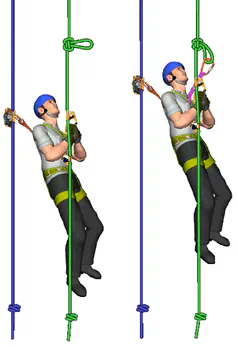
For many users, the loop isolating the damaged section of the rope remains unusable, and some training systems therefore do not allow a rope access technician to clip a personal lanyard (cowstail) to the loop when passing the knot [1, p. 15]. The question arises whether such caution is necessary, since the rope is doubled within the loop, meaning that the damage may not affect the overall strength of the knot. This question was precisely the motivation for a study conducted in the summer of 2021. The aim of the study was to determine whether damage to the loop affects the overall strength of the knot and whether a loop with such damage is sufficiently strong to secure a rope technician [2].
1 Materials
The tests were conducted on a vertical hydraulic testing machine (hereinafter referred to as the testing rig) with a maximum force capacity of 200 kN and a measurement accuracy of 0.5% [2, p. 3]. The tearing speed was manually controlled so that the displacement rate of the pulling mechanism did not exceed the standard-specified limit of 50 mm/min [3, Art. 4.1.2.2].
1.1 Rope
For the tests, new, previously unused, low-stretch ropes with a diameter of 10.5 mm1, type A, manufactured in January2 and June3 2021, and certified according to EN 1891, were used. These were white polyamide Truck ropes produced by Courant. According to the manufacturer, the static strength of the rope was 30 kN, the knot strength (using a figure-eight loop) was 19 kN, and the sheath contributes 47 % of the total rope strength [2, p. 2].
1.2 Test specimens
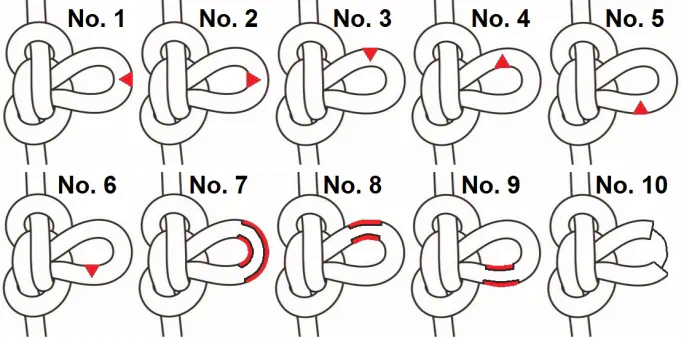
The knot chosen for the study was the alpine butterfly [5, Art. 6.1.2]. The research examined not only the effect of rope damage itself but also the influence of damage location on the strength of the butterfly loop. All test specimens were cut with a hot knife4:
- from the outer side of the upper part of the loop (Test 3),
- from the inner side of the upper part of the loop (Test 4),
- from the outer side of the apex of the loop (Test 1),
- from the inner side of the apex of the loop (Test 2),
- from the outer side of the lower part of the loop (Test 5),
- from the inner side of the lower part of the loop (Test 6).
Some of the tests focused on cases where the rope core was not damaged, but only the sheath. Therefore, certain test specimens (without using a hot knife) were completely stripped of the sheath:
- in the upper part of the loop (Test 8),
- at the apex of the loop (Test 7),
- in the lower part of the loop (Test 9).
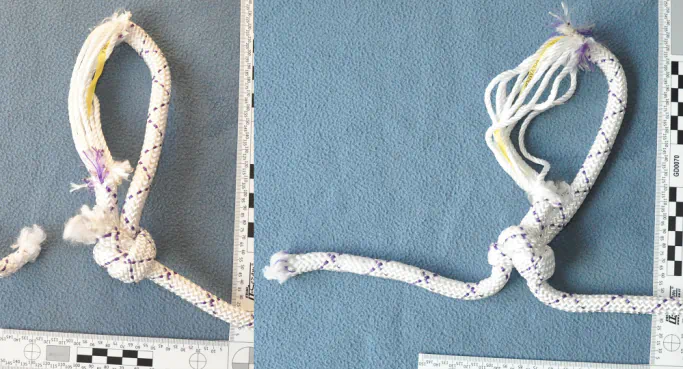
The last of the test specimens were stripped of the sheath and seven of the nine core strands. Only two core strands and the rope internal marking tape (hereafter referred to as marking tape) remained at the apex of the loop (Test 10).
2 Methods
The objective of the tests was to verify the suitability of using the knot loop to isolate a damaged section of rope. Specifically, the tests simulated a configuration in which the rope is anchored at the top by one strand exiting the knot, while the second strand remains unloaded, and the loop itself is loaded downward by the rope access technician. Accordingly, during testing, the knots were loaded both at the upper end of the rope and at the loop.
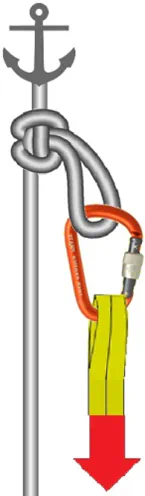
This configuration was achieved by clipping a connector to the loop in the same manner as used by a rope access technician and applying force to the loop in the direction of the anchorage.
The tests were conducted in the following order:
- Test 0 – testing undamaged knots to determine the rope strength in the knot,
- Test 1 – testing specimens damaged on the outer side of the apex of the loop,
- Test 2 – testing specimens damaged on the inner side of the apex of the loop,
- Test 3 – testing specimens damaged on the outer side of the upper part of the loop,
- Test 4 – testing specimens damaged on the inner side of the upper part of the loop,
- Test 5 – testing specimens damaged on the outer side of the lower part of the loop,
- Test 6 – testing specimens damaged on the inner side of the lower part of the loop,
- Test 7 – testing specimens stripped of the sheath at the apex of the loop,
- Test 8 – testing specimens stripped of the sheath in the upper part of the loop,
- Test 9 – testing specimens stripped of the sheath in the lower part of the loop,
- Test 10 – testing specimens composed of two core strands and the marking tape at the apex of the loop.
Each knot was properly dressed and statically preloaded with a force of 1.5 kN before the start of the test. Each test was performed three times (each case was tested in triplicate5). In total, 33 knots were tested, of which 30 had damage.
3 Results
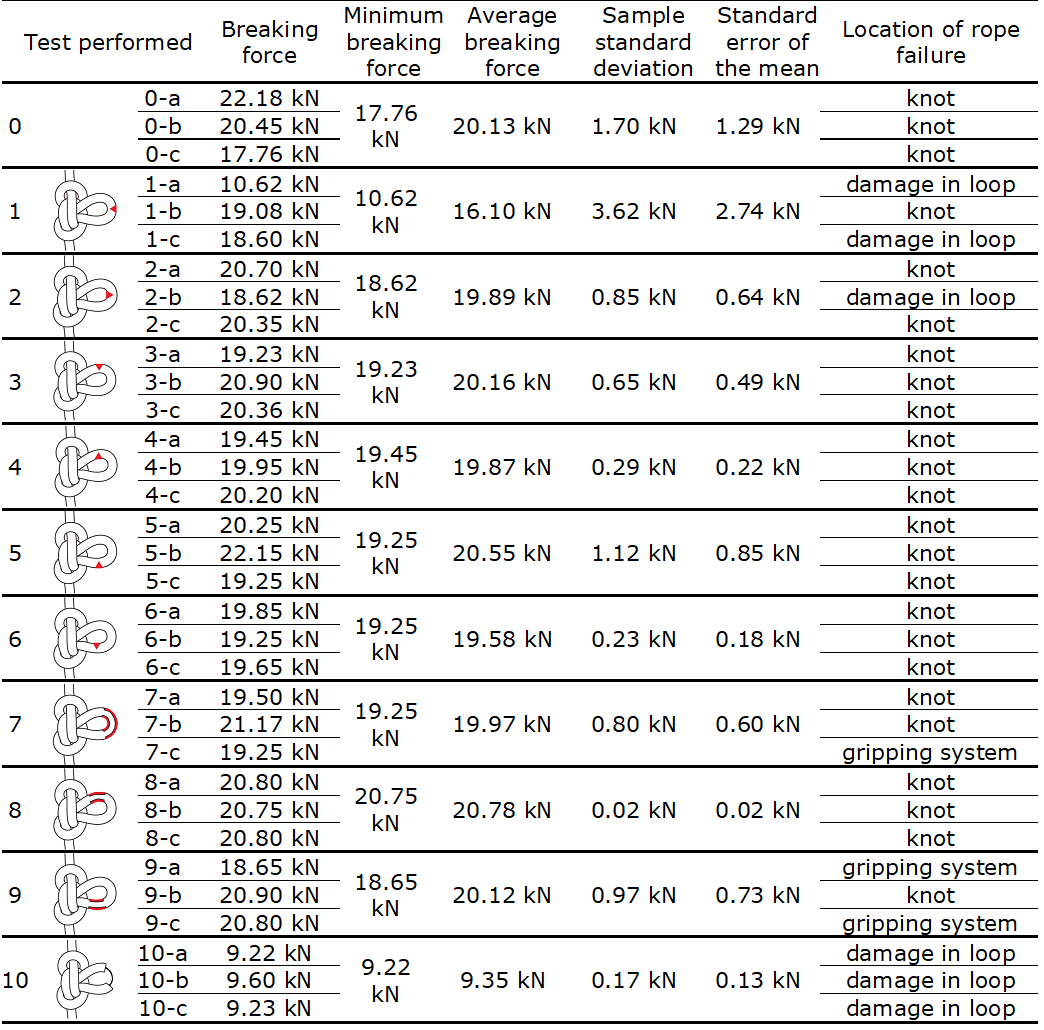
Of thirty tested alpine butterfly knots with loop damage:
- 21 cases resulted in rope failure within the knot itself, with no influence from the loop damage,
- 3 cases6 resulted in rope failure in the testing machine’s gripping system, with neither the knot nor the loop damage affecting the failure,
- 6 cases resulted in failure of the damaged loop, with a measurable reduction in the overall system strength, including:
- in 3 cases in which the loop consisted of only two core strands and the rope marking tape (Tests 10-a to 10-c),
- in 2 cases where the rope was cut on the outer side of the loop apex, with the cut depth only estimated (Tests 1-a and 1-c),
- in 1 case where the rope was cut on the inner side of the loop apex (Test 2-b).
In none of the tests (including those where the failure occurred at the site of the loop damage) did the force required to break the rope fall below 9 kN7.
3.1 Test 0 – Rope without any damage
The test designated as No. 0 served to determine the strength of an undamaged loop to enable comparison of the effects of individual types of damage.
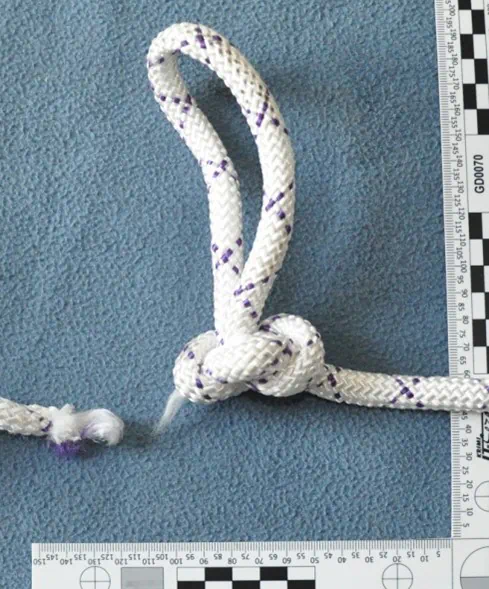
The strength of an undamaged alpine butterfly loaded via the loop was 20 ± 1.7 kN. In all cases, failure occurred within the knot itself rather than in the knot loop.
3.2 Test 1 – Damage to the outer side of the apex of the butterfly loop
In practice, damage to the rope located on the outer side of the apex of the loop is encountered most frequently. This results from the knot-tying process, in which the rope access technician instinctively bends the rope below the damaged section and subsequently completes the rest of the knot. Placing the damage at the apex of the knot makes it better visible, thereby increasing the likelihood that other rope technicians, who may not be aware of the rope damage, will notice it at the apex of the loop in time. Finally, locating the damage at the apex of the loop reduces the risk that, under changing loading conditions, the damaged section of rope will be drawn into the knot (i.e., that it will move from the loop into the knot body).
During the preparation of the first test specimens, a depth stop was not used, unlike in the subsequent specimens, and the depth of the cut – approximately half of the rope diameter – was only estimated.
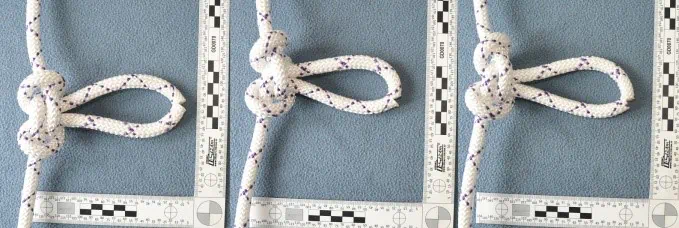
The very first test specimen (1-a) exhibited the deepest cut of all specimens, which was evident visually and was also reflected in the lowest measured strength during testing. The average strength of alpine butterfly knots damaged on the outer side of the apex of the loop was 16 ± 3.6 kN. In tests 1-a and 1-c, failure occurred in the loop at the location of the damage, whereas in test 1-b the knot itself failed, regardless of the loop damage. It should be reiterated that the cuts damaging the rope in these specimens were deeper than in all other test specimens.
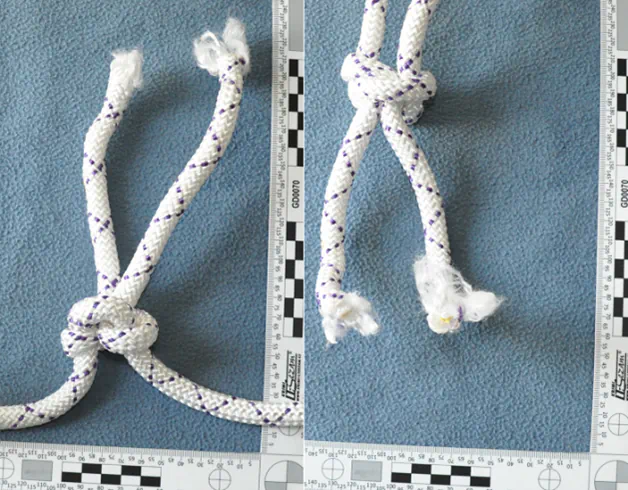
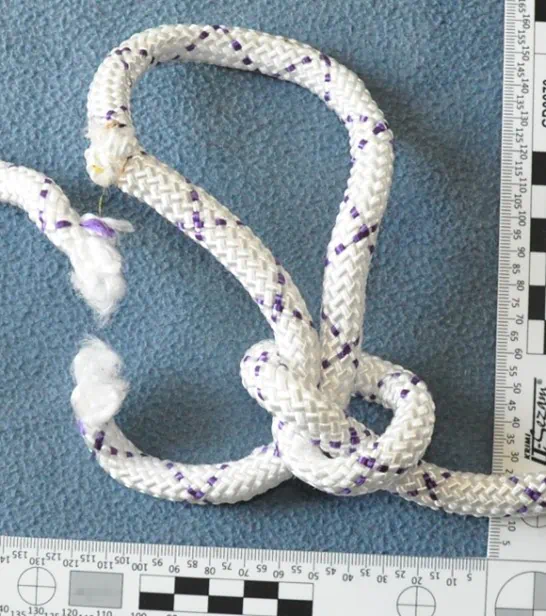
3.3 Test 2 – Damage to the inner side of the apex of the butterfly loop
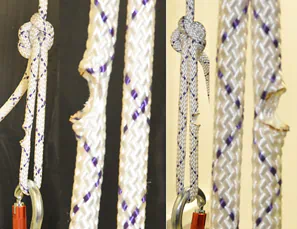
Failure of the rope at the location of the damage on the inner side of the apex of the knot occurred only in test 2-b, at a force of 18.62 kN. In the remaining two cases (2-a and 2-c), failure occurred in the knot itself, regardless of the damage to the rope within the loop. Alpine butterfly knots with damage on the inner side of the loop exhibited an average strength of 19.9 ± 0.85 kN.
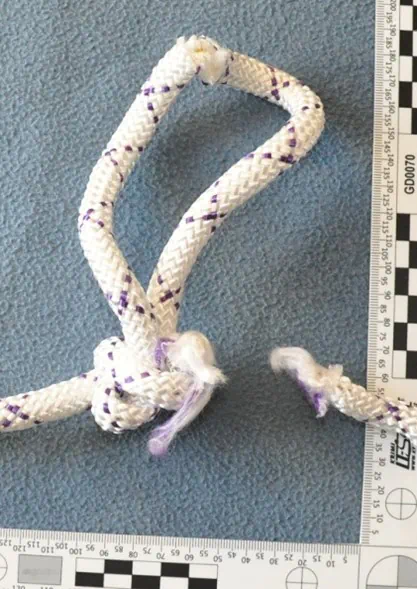
test [2, p. 8]
3.4 Test 3 – Damage to the outer side of the upper part of the butterfly loop
The upper part of the butterfly loop is defined as the portion of the loop that, when unloaded, is oriented upwards, away from the ground, and that, when the loop is loaded, does not come into contact with the free end of the rope hanging downward.
From a load-distribution perspective, configurations in which the damage is not located at the apex of the loop appear to be safer, as two sections of the loop are loaded evenly from the undamaged apex, one of which remains free of damage. In all three tests conducted within Test 3, failure occurred in the knot, while the damage to the loop had no effect on the overall strength of the system. The force required to break an alpine butterfly knot with loop damage located outside the apex was 20.2 ± 0.65 kN.
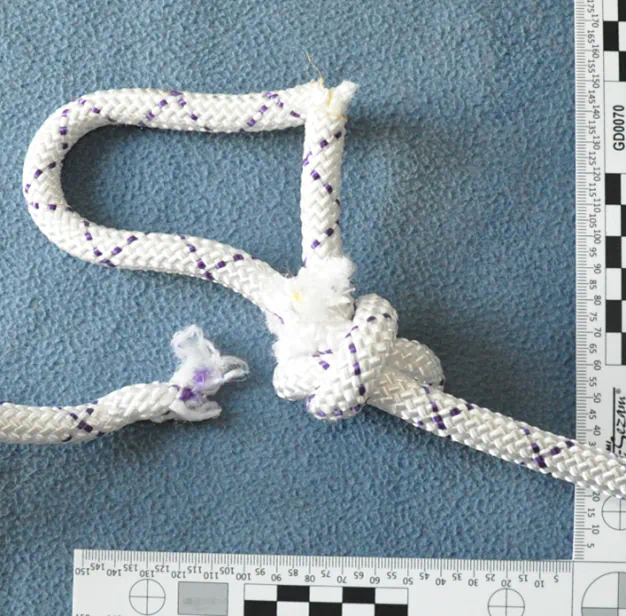
3.5 Test 4 – Damage to the inner side of the upper part of the butterfly loop
Even in the case of a butterfly loop with damage on the inner side of the upper part of the loop, the tests did not result in the failure of the damaged loop itself, but rather in failure of the knot. This occurred at a force of 19.9 ± 0.29 kN.
3.6 Test 5 – Damage to the outer side of the lower part of the butterfly loop
The lower part of the alpine butterfly loop refers to the section of the loop that, in an unloaded loop, is closer to the ground and, when the loop is loaded, comes into contact with the free end of the rope hanging below the knot.
Damage to the outer side of the loop in Test 5 did not affect the strength of the chain; in all three tests, the knot itself failed. Failure occurred at a force of 21 ± 1.1 kN.
3.7 Test 6 – Damage to the inner side of the lower part of the butterfly loop
Similar to the case of the loop damaged on the outer side, damage on the inner side did not affect the strength of the loop, and failure occurred in the knot at a force of 19.6 ± 0.23 kN.
3.8 Test 7 – Sheath removed from the apex of the butterfly loop
Removing the sheath from the rope at the apex of the loop would theoretically reduce the loop’s strength by 47% compared to its original strength. Nevertheless, in tests 7-a and 7-b, failure occurred in the knot (the damaged loop had no effect on the overall chain strength), and in test 7-c, the rope failed in the testing machine’s grip (i.e., completely outside the knot).
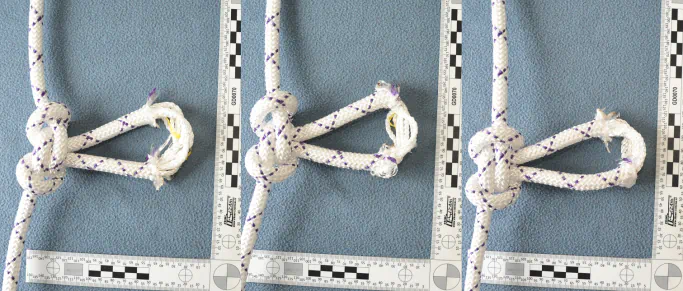
The knots failed at a force of 20 ± 0.8 kN. It is worth mentioning that during sheath removal for specimen 7-a, several yarns in one of the core strands were unintentionally cut.
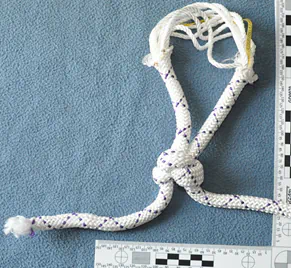
3.9 Test 8 – Sheath removed in the upper part of the butterfly loop
When testing alpine butterfly loops with the sheath removed in the upper part of the loop, the knot always failed (the removed sheath had no effect on the loop’s strength). Interestingly, during tests 8‑a and 8‑c, the rope marking tape was partially damaged (but did not break), and during test 8‑b, several yarns in two strands of the core were broken. The knots themselves failed at a load of 20.78 ± 0.02 kN.
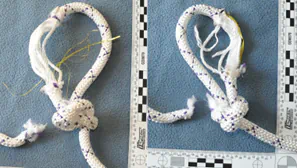
3.10 Test 9 – Sheath removed from the lower part of the butterfly loop
While testing alpine butterflies with the sheath removed from the upper part of the loop always resulted in the failure of the tested loop, in contrast, in the case of loops with the sheath removed from the lower part, two tests (9-a and 9-b) failed at the rope gripping system of the testing machine, and one test failed at the loop itself. In none of these cases did the removal of the sheath affect the overall strength of the chain, which was 20.1 ± 0.97 kN.
3.11 Test 10 – Apex of the loop consisting of two core strands and the marking tape
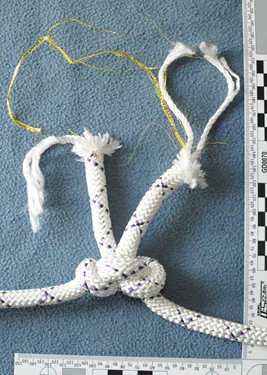
The last test examined the worst-case damage scenario, i.e., a rope stripped of its sheath and most of its core. Only two strands and the rope’s marking tape (internal marking) remained at the apex of the loop. In this test, unlike all others, the loop failed at the damaged site in every trial, at a force of 9.4 ± 0.17 kN. Interestingly, the marking tape itself did not break until a force of about 2 kN was applied (which does not imply that the tape alone can sustain 2 kN, but rather that the two remaining strands provided sufficient support for the tape to withstand forces up to this level).
4 Discussion
During the research conducted in the summer of 2021, 33 alpine butterfly loops were tested, of which 30 were damaged to varying degrees. Only six of them failed at the site of damage (i.e., only one fifth), and the force required to break the rope never dropped below 9 kN8.
The average force required to break all damaged knots (regardless of whether the failure occurred at the damaged loop, in the tested knot, or in the rope testing machine gripping system) was 18.64 ± 0.89 kN (median 19.75 kN).
Failure of the damaged loop9 occurred only when the damage was located at the apex of the loop. In one case, this happened at a force of 10.62 kN (for the specimen with the deepest cut), and in the remaining cases at 18.6 kN and 18.62 kN, respectively. This indicates that a damaged loop is weakest when the damage is located at its apex.
To decide whether a damaged alpine butterfly loop can be used (regardless of the location of the damage itself), the following factors must be considered:
- The minimum force at which rope failure occurred was 9.22 kN (in Test 10-a, where the apex of the loop consisted of only two core strands and the marking tape).
- A rope access technician with a weight of 120 kg exerts a force of approximately 1.18 kN10 downward in a static position.
In practice, it is generally accepted that the force (whether impact or braking) must not exceed 6 kN, as reflected in the requirements of technical standards [7, Art. 4.2.4; 8, Art. 4.4; 9, Art. 4.5 Table 2, Art. 4.5.2, Art. 5.5.2, Art. 4.5.5, Art. 4.5.7, Art. 4.5.8.2; 10, Art. 4.3.4; 11, Art. 7(b)]. This means that even in the worst-case scenario (i.e., a fall), the force acting on the rope access technician, their equipment, or the anchor point must not exceed this value.
In the case of ascenders (rope clamps), a minimum operating force of 4 kN is required [10, Art. 4.4.3, Art. 5.5.2; 12, Art. 4.3.3; 13, Art. 4.2.2, Art. 5.3.1, Art. 5.3.2], since most ascenders grip only the rope sheath. Excessive loading may result in the sheath being stripped. Therefore, while hanging on a rope an ascender can’t be used alone, but must always be used in combination with another device, e.g., another ascender, a lanyard (cowstail), or a descender [14, p. 69].
The strength requirements for anchoring cannot be overlooked. For anchor devices a strength of 12 kN is required (for non-metallic devices 18 kN) [11, Art. 4.4.3.5, 4.4.4.3, 5.3.4, 5.4.4.1, 5.5.4.1, 5.6.4.1, 5.7.4]; however, anchoring devices of classes A1, A2, B, or D according to the older standard valid until 2012, which required a strength of 10 kN [15, Art. 4.3.1.1, A2 4.3.1.2, 4.3.2, 4.3.4], are still in use. For permanent anchor devices, a minimum strength of 9 kN is required [16, Art. 4.2, Table 1]. Anchoring in mobile elevating work platforms must withstand a minimum static force of 6 kN [17, Art. 4.6.14(d)], and until the end of 2022, a static strength of 3 kN was required [18, Art. 5.6.14(b)].
Mention should also be made of accessory cords (so-called auxiliary cords or reep cords) often used in sport climbing, rescue operations, and arboriculture. For cords with a diameter of 4 mm, the standard requires a tensile strength of 3.2 kN; 5 mm cords must withstand 5 kN; 5.5 mm cords 6.1 kN; 6 mm cords 7.2 kN; and only cords with a diameter of 7 mm have a required minimum strength of 9.8 kN [19, Art. 4.2, Table 1].
Many of the equipment items used in rope activities are therefore not subject to as high strength requirements as both laypeople and professionals might assume. Damage to a loop of the knot essentially only brings its strength closer to that of some of these devices.
Most importantly, when standard equipment is used, the connection of the rope access technician to the main rope while overcoming an obstacle is always doubled. That is, even in cases where the technician clips to the knot loop with a lanyard, the technician is not connected solely via that loop but always has another device on the rope, usually an ascender. This ascender is not intended to arrest a fall (in the event of the knot loop failing), but it is also not designed to do so if the second ascender in the pair fails11.
On the other hand, it is essential to note that the tests were conducted using new, unused Courant Truck ropes with a diameter of 10.5 mm, manufactured in 2021. They do not account for possible differences due to rope age or wear, different rope diameters, different rope models (whether from the same manufacturer or others), or other factors. They also do not account for variations in the extent of damage, which will never be identical. Consequently, a damaged loop of the alpine butterfly may not withstand the same forces as observed in the tests, but it may also withstand significantly higher forces.
Furthermore, except for the removal of the sheath (Tests 7–9) and the removal of the sheath and more than half of the core (Test 10), the damage to the test specimens consisted of cutting the rope with a hot knife to approximately half of its diameter, so the extent of the damage was very similar. It can be assumed that the hot knife also affected the immediate area around the cut, which a standard blade or edge would not. Various other types of damage—whether mechanical (e.g., caused by falling objects, rope abrasion over an edge, wear from other personal protective equipment against falls, or rough handling), chemical, or thermal—were not investigated.
Even so, clipping to a damaged loop of the alpine butterfly must not compromise the user’s safety. Not only for peace of mind but primarily to maximize safety, it is advisable to use a double alpine butterfly and clip to both of its loops. Such an arrangement cannot endanger the rope access technician and, importantly, speeds up passing the knot.

Under no circumstances should the manufacturer’s instructions [20, p. 9], which specify how to handle a damaged rope, be ignored.
5 Conclusion
Tests were conducted on 30 alpine butterfly loops with various types of damage to the loop. The purpose of the tests was to determine whether damage to the rope at the loop would reduce its strength to the point of making the loop unsuitable for securing a rope access technician while passing the knot. The tests showed that this was not the case. In the vast majority of cases, the knot itself reduced the rope’s strength more than the damage to the loop.
Failure (of the tested loops, the rope, or the rope in the gripping system of the testing machine) occurred within a range of 9.22–22.18 kN (on average 18.64 ± 0.89 kN, median 19.85 kN), but in only four cases was the force required to cause failure less than 17 kN. Only six failures occurred at the site of damage, and in all of these cases, the damage was located at the apex of the loop (in three cases, the apex consisted of only two core strands and the marking tape). In all other cases, the rope failed in the tied knot or in the gripping system of the testing machine (the damage to the rope in the loop had no effect on the failure).
The findings indicate that even a damaged alpine butterfly loop provides sufficient strength for securing a rope access technician (provided that, in addition to clipping to the loop, another item of personal protective equipment against falls is connected to the rope). However, it is crucial that the rope damage is not located at the apex of the loop.
It should also be emphasized that the measured values were obtained under laboratory conditions on new samples from a single manufacturer, of a specific type and diameter. Furthermore, three tests per scenario are only indicative and should not be considered fully conclusive. Nevertheless, the tests provide valuable information and can serve as a starting point for further research, during which dozens of different ropes in various conditions, from different manufacturers, and with various types of damage, could be examined.
References
[1] Society of Professional Rope Access Technicians (SPRAT). Rope Access Evaluation Guidelines. Wayne (PA): SPRAT, 2025. Available at: https://sprat-external.cloud.alphasoftware.com/download.a5w?id=64.
[2] BELICA, Ondřej and Jan SMOLEK. Influence of damage of the loop on the strength of an alpine butterfly. Czech Rope Access Association [online], 11. 8. 2021. Dostupné https://craa.cz/wp-content/uploads/2021/08/strength-of-damaged-butterfly.pdf.
[3] EN 364 Personal protective equipment against falls from a height. Test methods. Prague: Czech Standards Institute, 1996. Sorting symbol: 832660.
[4] EN 1891 Personal protective equipment for the prevention of falls from a height – Low stretch kernmantel ropes. Prague: Czech Standards Institute, 2000. Sorting symbol: 832641.
[5] ČSN 83 2610 Knots – Terminology. Prague: Czech Standardization Agency, 2021. Sorting symbol: 832610.
[6] SMOLEK, Jan. Metrologie – Hodnocení přesnosti měřené veličiny, Nejistoty měření. Brno: SPŠS Brno, 2015.
[7] EN 363 Personal fall protection equipment – Personal fall protection systems. Prague: Czech Standardization Agency, 2019. Sorting symbol: 832650.
[8] EN 355 Personal protective equipment against falls from a height – Energy absorbers. Prague: Czech Standards Institute, 2003. Sorting symbol: 832622.
[9] EN 360 Personal fall protection equipment – Retractable type fall arresters. Prague: Czech Standardization Agency, 2019. Sorting symbol: 832624.
[10] EN 12841 Personal fall protection equipment – Rope access systems – Rope adjustment devices. Prague: Czech Standardization Agency, 2024. Sorting symbol: 832635.
[11] EN 795 ČSN EN 795 Personal fall protection equipment – Anchor devices. Prague: Office for Standards, Metrology and Testing, 2013. Sorting symbol: 832628.
[12] EN 12841 Personal fall protection equipment – Rope access systems – Rope adjustment devices. Prague: Czech Standards Institute, 2007. Sorting symbol: 832635.
[13] EN 567 Mountaineering equipment – Rope clamps – Safety requirements and test methods. Prague: Office for Standards, Metrology and Testing, 2013. Sorting symbol: 942004.
[14] BELICA, Ondřej. Práce a záchrana ve výškách a nad volnou hloubkou. Prague: Grada, 2014. ISBN 978-80-247-5055-2.
[15] EN 795 Protection against falls from a height – Anchor devices – Requirements and testing. Prague: Czech Standards Institute, 1998. Sorting symbol: 832628.
[16] EN 17235 Permanent anchor devices and safety hooks. Prague: Czech Standardization Agency, 2025. Sorting symbol: 747726.
[17] EN 280-1 Mobile elevating work platforms – Part 1: Design calculations – Stability criteria – Construction – Safety – Examinations and tests. Prague: Czech Standardization Agency, 2023. Sorting symbol: 275004.
[18] EN 280+A1 Mobile elevating work platforms – Design calculations – Stability criteria – Construction – Safety – Examinations and tests. Prague: Office for Standards, Metrology and Testing, 2016. Sorting symbol: 275004.
[19] EN 564 Mountaineering equipment – Accessory cords – Safety requirements and test methods. Prague: Czech Standardization Agency, 2023. Sorting symbol: 942001.
[20] WAGNER, Josef, BELICA, Ondřej. Právní důsledky nehody na sportovním lanovém traverzu. Safety, Work And Rescue Magazine. 2024. roč. 1, č. 1, s. 4-12. ISSN 3029-7508. Available at: https://doi.org/10.71319/swarm2401.04-12.
- Prior to testing, the rope diameter [4, Art. 5.3] was verified, revealing an actual diameter of 10.69 mm. ↩︎
- Test specimens manufactured in January 2021 were used for Tests 0–7. ↩︎
- Test specimens manufactured in June 2021 were used for Tests 8–10. ↩︎
- It is likely that not all cuts made with the hot knife were of equal depth. The deepest cuts occurred during the first set of tests, i.e., specimens 1-a, 1-b, and 1-c, for which the depth was only estimated. In all other cases, a stop fixture was used to ensure that the cut depth corresponded to the rope radius. ↩︎
- Three measurements are considered the minimum reasonable number of repetitions, allowing for a meaningful estimate of variability and basic assessment of measurement dispersion [6]. A higher number of measurements would provide a more reliable estimate of measurement uncertainty; however, it should be noted that the aim of the study was to assess the significance of rope damage in the loop for securing into it when passing the knot, not to study the precise effect of rope damage on the strength of the rope system. ↩︎
- In one case, the rope was from early 2021, and in two cases, from June 2021. ↩︎
- For Test 10, the force ranged from 9.22 to 9.60 kN; for Test 1‑a, it was 10.62 kN; and for Tests 1‑c and 2‑b, a force of 18.60 kN was required. ↩︎
- In three cases, the loop consisted of two core strands and the marking tape, with failure occurring at a force of 9.4 ± 0.17 kN. In the remaining cases, failure occurred when the damage was located at the apex of the loop: twice on the outer side of the apex and once on the inner side. For the more deeply notched specimen 1‑a (outer side), failure occurred at 10.62 kN; in another case (1‑c, also outer side) at 18.60 kN; and in the third case (Test 2‑b, inner side) at 18.62 kN. ↩︎
- Except for Test 10, in which the apex of the loop consisted only of two core strands and the marking tape. ↩︎
- During movement or in the event of a fall, the peak force may exceed this value, depending on the fall length, the connecting device used (e.g., lanyard/cowstail), the distance (length of rope) between the anchor point and the bypassed knot, and the rope on which the butterfly is tied (tightening the knot at the moment of fall arrest reduces the impact force), as well as the use of an energy absorber. ↩︎
- For example, in cases where the second ascender fails or damages the rope ↩︎
- Po ověření průměru lana [4, čl. 5.3], které předcházelo zkoušce, se skutečný průměr lana ukázal 10,69 mm. ↩︎
- Na zkušebních vzorcích vyrobených v lednu 2021 proběhly testy 0–7. ↩︎
- Na zkušebních vzorcích vyrobených v červnu 2021 proběhly testy 8–10. ↩︎
- Je pravděpodobné, že ne všechny zářezy horkým nožem byly stejně hluboké (nejhlubší byly u 1. zkoušky, tzn. u zkušebních vzorků 1-a, 1-b a 1-c, kdy jejich hloubka byla pouze odhadnuta. Ve všech ostatních případech byl při řezání použit dorazový přípravek tak, aby hloubka řezu odpovídala poloměru lana). ↩︎
- Tři měření jsou považována za nejnižší rozumný počet opakování, umožňující poskytnout smysluplný odhad rozptylu a základní posouzení variability měření [6]. Vyšší počet měření by poskytl spolehlivější odhad nejistoty měření, na druhou stranu je nutné si uvědomit, že záměrem výzkumu bylo zjistit význam poškození lana v oku pro potřeby zajištění se do něj při překonávání uzlu, nikoliv studie o míře vlivu poškození lana na pevnost lanového řetězce. ↩︎
- V jednom případě se jednalo lano z počátku roku 2021, ve dvou případech o lano z června roku 2021. ↩︎
- U testů č. 10 byla síla v rozmezí 9,22 – 9,60 kN, u testu 1-a pak 10,62 kN, a u testů 1-c a 2-b bylo zapotřebí síly 18,60 kN. ↩︎
- Ve třech případech to bylo u oka tvořeného dvěma prameny jádra a identifikační páskou, kdy k přetržení docházelo u síly 9,4 ± 0,17 kN. V dalších případech to bylo, pokud bylo poškození na vrcholu oka, z toho dvakrát na vnější straně vrcholu oka a jednou na vnitřní straně vrcholu oka. U více naříznutého zkušebního vzorku 1-a (vnější strana) došlo k přetržení u síly 10,62 kN, v dalším případě (1-c, taktéž vnější strana) při síle 18,6 kN a ve třetím případě (zkouška 2-b, poškození na vnitřní straně) došlo k přetržení při síle 18,62 kN. ↩︎
- S výjimkou testů č. 10, u nichž vrchol oka byl tvořen pouze dvěma prameny jádra a identifikační páskou. ↩︎
- Při pohybu nebo případě pádu rázová síla tuto hodnotu překročí, v závislosti na délce pádu, použitém spojovacím prostředku (odsedací smyčce), vzdálenosti (délce lana) mezi kotevním bodem a překonávaným uzlem, a laně, na němž je motýlek uvázán (dotahování motýlka v okamžiku zachycení pádu se promítne do snížení rázové síly), případně na použití tlumiče pádové energie. ↩︎
- Např. v případech, kdy druhý blokant selže nebo poškodí lano. ↩︎